OpenAPI to MCP is only the beginning
Teams evaluating OpenAPI to MCP often assume that if a generator can parse an OpenAPI spec or Swagger spec and output a Model Context Protocol server, the hard part is done. In practice, that is only the first step.
A raw API to MCP workflow creates technical output. It does not automatically create an agent-ready API. Real production teams need an interface that is compact, understandable, governed, and safe enough for live agent traffic. That is where curated MCP servers matter.
Generating an MCP server is easy. Building a clean agent interface layer with context window optimization, MCP auth, and production safety is the real problem.
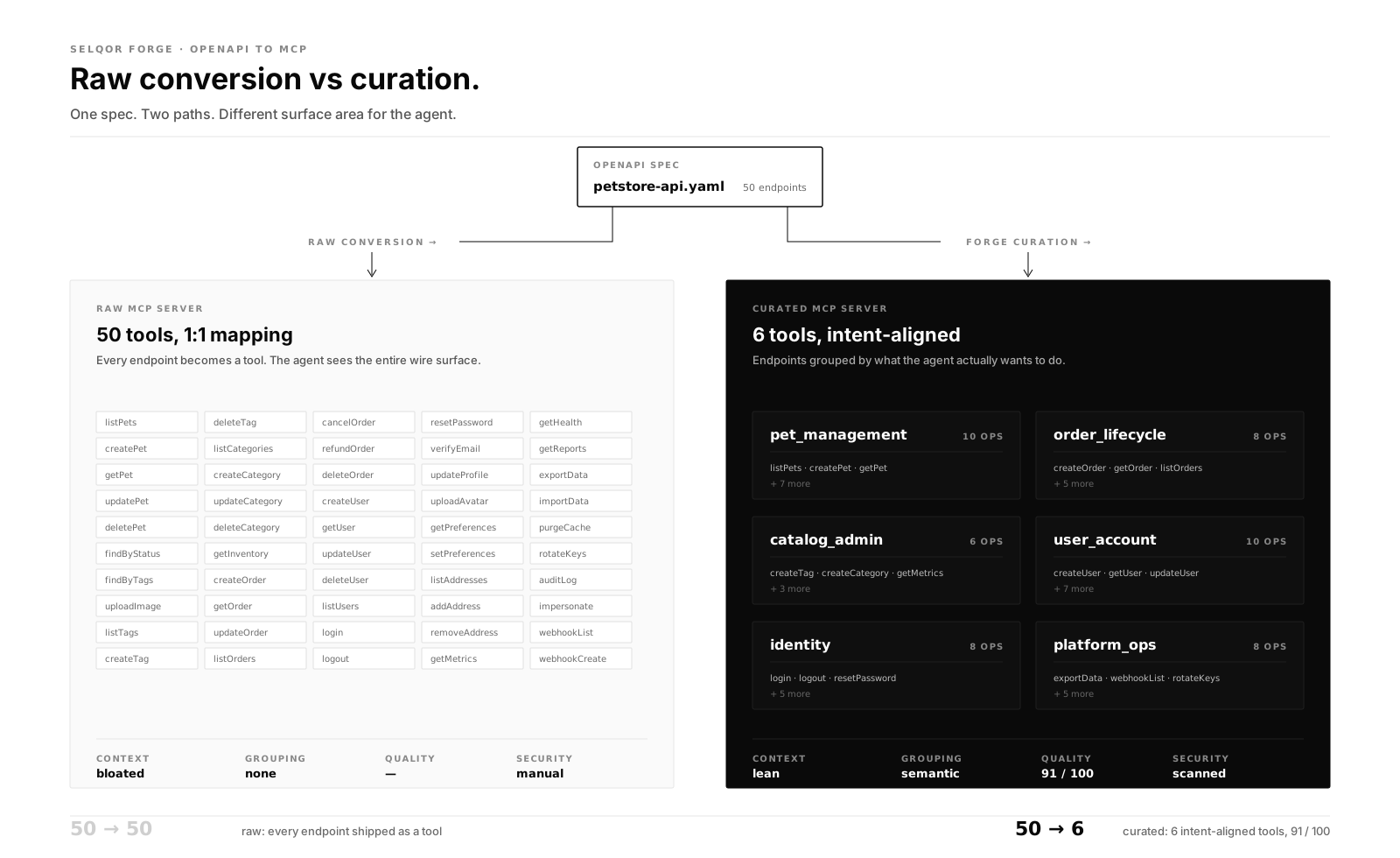
Why raw OpenAPI to MCP generation breaks down in production
A typical OpenAPI to MCP converter or MCP server generator reads an OpenAPI spec, maps operations into tools, generates a Model Context Protocol server, and exposes that surface to an agent runtime.
That output is useful for prototypes. It proves an API can be represented in MCP and gives teams a fast starting point. But production systems need more than generated output. They need a compact, governed interface that agents can actually use well.
Most real APIs are messy. They have inconsistent naming, overlapping operations, legacy routes, weak descriptions, and auth rules that make sense to internal backend teams but not to agents. A raw Swagger to MCP workflow inherits all of that noise.
Tool sprawl hurts agent performance
Many generated MCP servers expose too many tools. That bloated tool surface forces the model to pick from overlapping operations, increasing confusion and hurting context window optimization. More tools often means lower signal, not more power.
Backend naming does not equal agent clarity
Route names that make sense to internal engineering teams rarely make a good agent interface layer. Agents need action-oriented names, stronger descriptions, and clearer boundaries between related tasks.
MCP auth is still a real blocker
A generated server is not automatically secure. MCP auth, scope boundaries, and write controls still need to be designed for machine traffic. That is a major blocker for enterprise MCP adoption.
Not every endpoint belongs in an agent-facing surface
Internal admin routes, destructive actions, low-value maintenance endpoints, and duplicated operations should not be exposed by default. Raw conversion can turn your MCP layer into a new attack surface.
Most generators do not score interface quality
Without MCP quality scoring, teams have no clear signal for whether the generated interface is compact, useful, and likely to perform well in production.
Most workflows stop before security review
Production MCP requires MCP security scanning, endpoint review, auth validation, and policy checks before deployment. Raw generation usually stops too early.
Raw generation vs curated generation
The difference is simple: raw generation gives you a server, while curated generation gives you a usable interface.
| Dimension | Raw OpenAPI to MCP generation | Curated MCP servers |
|---|---|---|
| Output | Direct tool mapping from spec | Intent-shaped agent interface |
| Tool count | Often bloated | Reduced for context window optimization |
| Naming | Mirrors backend operations | Optimized for agent understanding |
| Grouping | Endpoint-first | Semantic tool grouping and intent-based tool planning |
| MCP auth | Manual or incomplete | Designed with scope and governance controls |
| Security review | Minimal | MCP security scanning before launch |
| Quality signal | Usually absent | MCP quality scoring and benchmark review |
| Deployment readiness | Prototype-friendly | Production-ready MCP servers |
How Selqor MCP Forge turns OpenAPI specs into curated MCP servers
Selqor MCP Forge is built for teams that want more than a basic MCP server generator. The goal is not just conversion. The goal is a cleaner, safer, more useful agent interface layer from the APIs you already own.
A curated MCP server is shaped before it is shipped: the API surface is normalized, tools are grouped by intent, low-signal endpoints are filtered out, auth boundaries are applied, and the resulting interface is reviewed for clarity and operational quality.
1. Ingest the source spec
Forge starts with an OpenAPI spec or Swagger spec from your existing API platform, internal service contracts, or exported definitions.
2. Normalize the surface
Instead of mirroring route-level inconsistencies, Forge applies API normalization to create a more coherent starting point.
3. Group by agent intent
With semantic tool grouping and intent-based tool planning, Forge shapes the interface around what agents are actually trying to accomplish. That reduces tool sprawl and improves agent performance.
4. Apply MCP auth and controls
Forge helps teams account for MCP auth, provider behavior, and governance boundaries before they ship.
5. Score the resulting surface
With MCP quality scoring, teams can judge whether the interface is compact, clear, and ready for production use.
6. Generate deployment-ready targets
Forge produces targets engineered for real delivery workflows, not just prototype output. That is how teams move toward production-ready MCP servers.
7. Scan before launch
Forge supports MCP security scanning and pre-launch validation so teams do not expose an unreviewed surface to live agents.
How to scan an MCP surface before production
Any team adopting enterprise MCP should ask what happens before deployment. A solid review process should cover the following.
- Endpoint exposure: remove admin routes, destructive tools, and low-value actions that should never be broadly available.
- Auth and scopes: validate MCP auth, agent identity, and least-privilege boundaries across read and write workflows.
- Tool redundancy: reduce overlapping operations that waste context and confuse tool selection.
- Description quality: review whether each tool tells the model when to use it and what it does.
- Error behavior: inspect retry, timeout, and failure patterns before agents learn the wrong habits in production.
- MCP security scanning: check for auth gaps, weak defaults, overbroad scopes, and other deployment risks.
- MCP quality scoring: benchmark clarity, compactness, and likely agent behavior over time.
If your MCP surface has never been scored, reviewed, or scanned, it is not ready for governed MCP deployment no matter how quickly it was generated.
Why Selqor MCP Forge is built for governed MCP, not just generated MCP
The easy part of API to MCP is code generation. The hard part is shaping a compact, governed, efficient interface that agents can use safely and consistently.
Selqor MCP Forge focuses on that second problem. We believe the future of OpenAPI to MCP will not be won by whichever tool exposes the most endpoints the fastest. It will be won by whoever helps teams build the best curated MCP servers with the least noise, the strongest controls, and the highest confidence before production.
Raw generation answers, "Can this API be turned into MCP?" Curated generation answers, "Should agents use this surface in production?" For real systems, only the second question matters.